What you can do with it
Turn it on for a task and the agent can browse the web as part of its work:- Verify a deployed site — “open the staging URL and tell me whether the pricing page renders and the CTA works.”
- Reproduce a bug behind a login — navigate an authenticated app and capture exactly what the user sees.
- Read a page — “open this article and summarize the top items,” or grab a page’s heading, prices, or table.
- Drive a flow — fill a form, click through a multi-step wizard, follow links.
- Research across sites — gather and compare information from several pages in one task.
Watch it live — and keep the screenshots
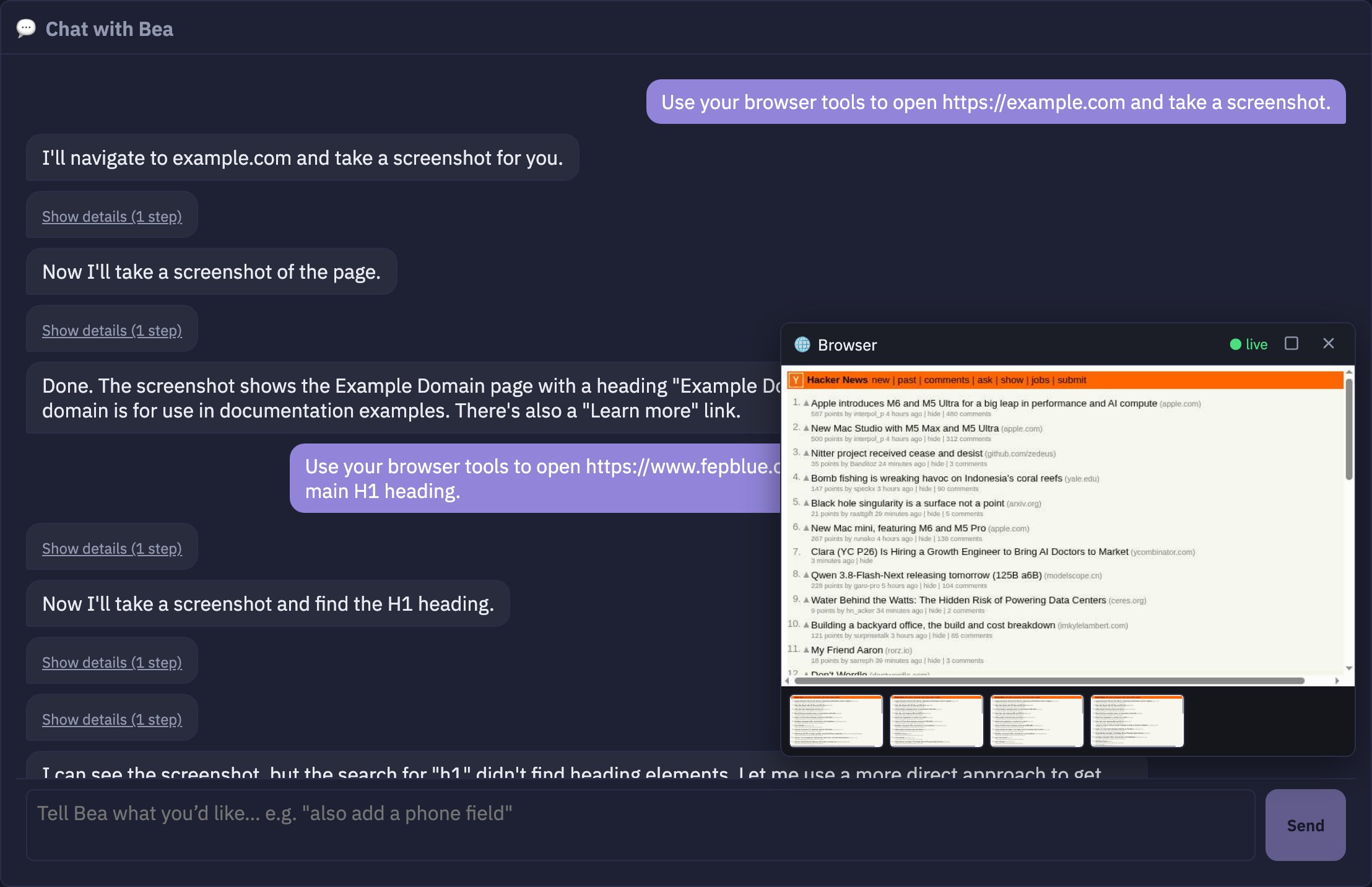
The live Browser panel — the agent's browser streams in real time next to the chat/terminal, with the screenshots it captured below.
- A Browser panel shows the agent’s browser as it happens — every page it opens, live, whether you’re in the chat view or the developer view.
- Each navigation is captured as a screenshot you can click to preview.
- The screenshots are saved with the task, so they’re still there when you come back later — reopen the panel any time from the 🌐 Browser chip.
Two backends — pick isolation or speed, per task
Choose the browser backend for each task from the New Task form:Turn it on
1
An admin enables it for the org
In Admin → Agent LLM, turn on the browser agent. For the rtrvr backend, add the org’s rtrvr
API key in the same panel (Grid needs no key).
2
Pick a backend on the New Task form
Under Advanced options, set 🌐 Browser agent to Grid or rtrvr.
3
The agent gains web-browsing tools
It navigates, screenshots, reads, and fills pages on its own — and you watch it in the Browser
panel.
The browser agent is off by default — browsing is an explicit opt-in, both at the org level
and per task, so a task only reaches the web when you choose it.